 English
 Español
 عربى
عربى
Home / News / Industry News / What Makes a Circulating Hot Air Smokehouse Essential for Modern Food Processing Plants?



Smoking remains one of the most trusted methods for flavoring and preserving meat, fish and bean products, but scaling it up presents a different set of challenges. In a traditional smoke room, heat rises naturally, so the upper shelves run hotter and smoke settles unevenly. Operators compensate by rotating trays, extending cycle times and accepting color differences from batch to batch. A circulating hot air smokehouse takes a different approach by moving heated air through the chamber with a dedicated fan, so every product surface sees a similar environment.
This guide explains how the system works, where it fits best, what to look for when comparing equipment, and how daily operation affects final quality. The goal is practical: help production managers and engineers make a confident decision based on data rather than general marketing claims.
These figures represent typical operating ranges reported across many installations. They are not guarantees for every product, because actual results depend on load density, product size, moisture content and the recipe in use.
The core principle is forced convection. A heating element warms the air, a fan drives it across the product load, and the air returns to the heater to be reheated. This closed loop keeps the chamber close to its set temperature while heat, moisture and smoke are carried evenly over every tray.
Each stage of the loop plays a specific role:
Because the air is always moving, heat transfer to the product is faster than in static systems. Many plants report noticeably shorter drying phases, which directly raises throughput on the same floor space.
Well-designed units aim for a spread of roughly plus or minus 2 degrees Celsius across the working zone. Uniformity is verified during commissioning by placing calibrated probes at several heights and corners. Ask any supplier for this mapping data before purchase, because it reveals far more than a single display reading.
Air that moves too slowly leaves a stagnant boundary layer around each product, which delays color development. Air that moves too fast can dry the surface before the interior reaches a safe temperature, causing case hardening. Most processors settle on a velocity range that suits their product thickness and fat content.
The benefits are easiest to see when the two approaches are compared side by side. The table below uses typical ranges reported by processing plants rather than single-model specifications.
| Factor | Natural convection smoke room | circulating hot air smokehouse |
|---|---|---|
| Temperature spread | 8 to 15 degrees Celsius | About 2 to 4 degrees Celsius |
| Typical cycle time | 8 to 12 hours | 4 to 7 hours |
| Color consistency | Frequent rework needed | Repeatable across racks |
| Labor per batch | High, manual tray rotation | Low, program-driven |
| Energy per kilogram | Higher due to long cycles | Lower with shorter cycles |
Buyers of cured meats and smoked fish judge products heavily on surface color. When every rack sees the same air temperature and smoke density, the finished batch looks uniform, which reduces grading losses. Several plants report fewer rejected units after moving from static rooms, although results vary with recipe and load.
Stainless steel construction with smooth internal corners and removable racks makes sanitation faster. Look for sloped drain points, accessible fan housings and a clear separation between raw and cooked zones. Good design reduces residue buildup in areas where air stagnates.
Shorter cycles and better heat transfer lower the energy needed per batch. Automated programs also reduce the labor required to monitor and adjust trays, allowing operators to focus on quality checks instead of manual rotation.
The same basic process supports several product families, although each one requires its own recipe and cycle profile.
Sausages, hams and bacon benefit most from stable airflow, because internal temperature targets must be reached without drying the outer casing too early. Typical programs combine a drying stage, a smoking stage and a final setting or cooking stage.
Fish fillets and whole fish need gentle drying followed by controlled smoke exposure. Moderate airflow helps prevent skin cracking and keeps the flesh moist. Plants processing several species usually store separate recipes for each thickness range.
Dried tofu sheets, tofu skin and similar products need even moisture removal to avoid brittle edges. Circulating air dries these items uniformly, improving texture consistency across large batches.
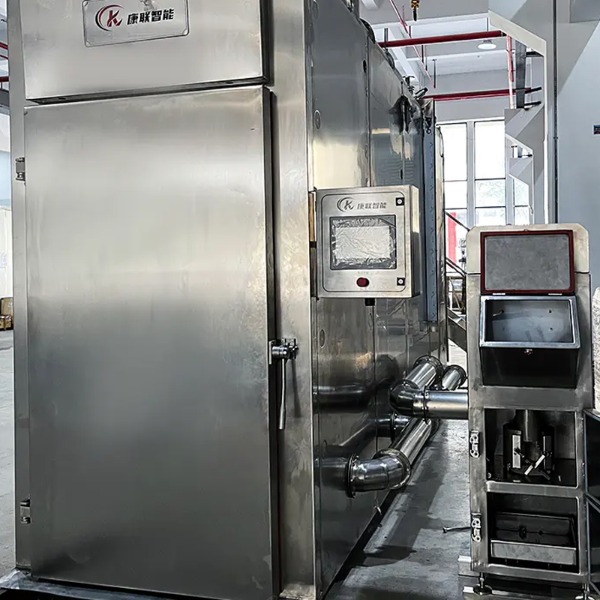
Consider a mid-sized plant that produces smoked sausages and dried bean products across two shifts. The team wants to replace an aging natural convection room and needs operating data to justify the investment. The table below summarizes a simplified planning model based on typical figures from similar operations.
| Item | Old smoke room | New circulating system |
|---|---|---|
| Batches per day | 3 | 5 |
| Rejects from color issues | Around 6 percent | Around 2 percent |
| Operators per shift | 3 | 2 |
| Energy per batch | Higher baseline | Lower baseline |
In this scenario, the plant gains two extra batches per day, cuts color-related rejects by several percentage points and frees one operator per shift for quality checks. The payback period depends on local energy prices and labor costs, so each plant should run its own analysis using supplier data.
Planning usually follows a clear sequence:
Choosing equipment depends less on headline specifications and more on how well a machine fits your products, floor layout and quality targets. The criteria below cover the decisions that most often affect long-term results.
Start with daily output and the number of cycles your team can run per shift. A unit that is too small creates bottlenecks, while an oversized one wastes energy when partially loaded. Many buyers select a model that handles peak demand but still runs efficiently at normal volume. Check rack spacing, door clearance and trolley paths before finalizing.
Food-contact surfaces should use corrosion-resistant stainless steel that tolerates salt, smoke and cleaning chemicals. Request material certificates and confirm the grade used for the chamber, fan housing and fasteners. Weld quality and surface finish matter as much as the base metal.
A reliable control panel should store multiple recipes, log temperature and humidity over time, and alert operators to deviations. Recipe repeatability is one of the biggest advantages of automation, so ask how many programs can be saved and how data can be exported for traceability.
Compare insulation thickness, door sealing and exhaust management. Some designs recover part of the exhaust heat to preheat incoming air, reducing energy demand. Ask for estimated consumption per batch under your own product load, not only under empty-chamber test conditions.
Verify that the equipment supports your hygiene management system. Request drawings, material lists, operation manuals and calibration records. A well-documented smoking oven simplifies audits and shortens the time needed for process qualification.
Even the best equipment depends on how it is run. The following practices help plants achieve consistent results across every cycle.
Operators who log every cycle usually identify a clear pattern within a few weeks. Small shifts in load density or ambient temperature often explain most quality variation, which makes preventive adjustment far easier than correcting rejected batches.
Several issues appear repeatedly in plants that struggle with a new system. Avoiding them early saves time and material.
Another frequent error is judging performance only from empty-chamber tests. Real results depend on the product, so pilot batches using your own formulations should guide the final settings.
The main difference is forced air movement. A fan circulates heated air across the product, which narrows temperature differences and speeds up drying and smoking compared with natural convection.
Yes. Most systems run multi-stage programs that combine drying, smoking, cooking and finishing in one chamber. This reduces handling between steps and keeps product inside a controlled environment.
Cycle times vary with product type and size. Many meat and fish programs fall between four and seven hours, while thicker products or heavier loads may require longer.
Ask for material certificates, drawings showing drainage and access points, cleaning instructions and documentation that supports your food safety plan. Confirm that the design allows complete sanitation between production runs.
Start with daily output for each product, then compare it with the number of cycles your team can realistically run. Add a margin for maintenance and peak orders, and confirm the result with the supplier using your actual loading pattern.
This type of smokehouse offers a practical route to consistent color, predictable cycle times and easier sanitation for meat, fish and bean processing. The decision should rest on your product mix, daily output, layout constraints and documentation needs rather than on general claims.
Begin with pilot batches, collect temperature and yield data, and compare several proposals using the same criteria. A structured evaluation usually reveals which features genuinely matter for your line and which are optional extras.
Introduction: The New Era of Food Defrosting Technology The global demand for frozen food products h......
READ MOREIntroduction to Advanced Food Preservation The evolution of food preservation technology has reached......
READ MOREIntroduction: What Is a Tunnel Freezer? A Tunnel Freezer is a specialized industrial freezing system......
READ MORE1. Introduction In the context of the global food processing industry's continuous growth, food safe......
READ MOREDevelopment Concept
Guided by our core principle of quality, we have always adhered to the business purpose of "starting with pursuit and ending with satisfaction.
 +86-13967365006
 +86-573-82723906
 zhejiangkanglian@gmail.com
 No. 351 Xinfei Road, Fengqiao Town Industrial Park, Nanhu District, Jiaxing City, Zhejiang Province, China
Copyright © 2023 Zhejiang Kanglian Intelligent Equipment Co., Ltd. All Rights Reserved. Privacy Global Technical Support for Custom Food Processing Equipment


