 English
 Español
 عربى
عربى


In modern food processing, achieving superior texture and consistent flavor is a persistent challenge. Traditional marination methods often fall short due to long processing times, uneven seasoning distribution, and undesirable changes in product structure. Over the past decade, vacuum tumbling technology has emerged as a transformative solution, directly addressing these issues with measurable improvements in both sensory qualities and operational efficiency.
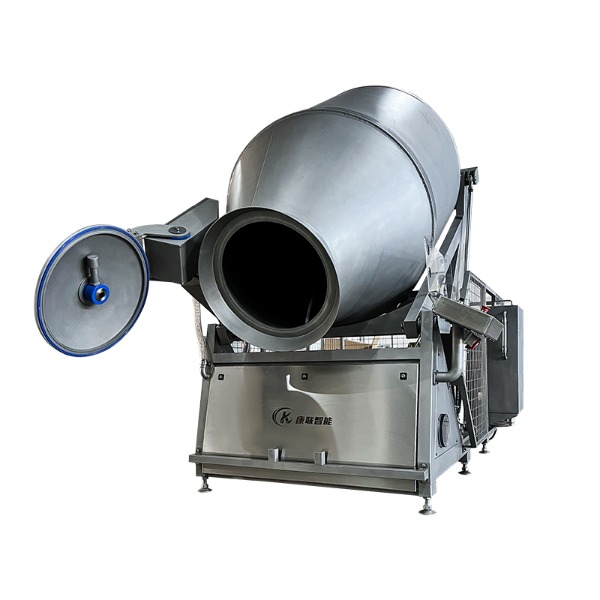
Vacuum tumbling refers to a mechanical process in which food products—typically whole-muscle meats, poultry, seafood, or vegetables—are placed inside a rotating drum. The drum is sealed and air is partially or fully evacuated before or during rotation. This vacuum environment triggers several physical and chemical changes that conventional tumbling cannot achieve.
Under atmospheric pressure, pores within food tissues remain closed or partially collapsed, limiting the penetration of brine, spices, or curing agents. When air is removed, those pores open up, allowing liquids to infiltrate more deeply and uniformly. Simultaneously, the mechanical action of the rotating drum gently massages the product, breaking down muscle fibers without excessive tearing. This dual mechanism—vacuum-induced permeability plus mechanical tenderization—is the foundation of enhanced texture and flavor.
A standard vacuum tumbler machine operates in cycles of vacuum application, rotation, and controlled release. Parameters such as drum speed, tilt angle, vacuum level, and cycle duration can be precisely adjusted depending on the product type. For delicate items like fish fillets, low-speed intervals with intermittent vacuum are used. For dense cuts of beef or pork, higher vacuum levels and longer tumbling cycles accelerate protein extraction, which improves water-holding capacity and final juiciness.
Texture is a primary quality attribute in meat and plant-based protein products. Consumers expect consistent bite, mouthfeel, and structural integrity. Vacuum tumbling directly improves texture through three mechanisms:
Myofibrillar protein extraction – The combination of vacuum and mechanical action pulls salt-soluble proteins to the surface of meat pieces. When cooked, these proteins form a gel-like network that binds moisture and fat, resulting in a firmer yet more tender bite.
Reduced purge loss – Purge (exudate loss) during storage or cooking is minimized because the tissue’s ability to retain water is enhanced. Products processed in a vacuum tumbler machine typically show lower drip loss, translating to a juicier eating experience.
Controlled fiber disruption – Unlike needle tenderization, which can create channels for bacterial ingress, vacuum tumbling gently separates fiber bundles. This preserves the product’s natural appearance while improving tenderness.
For example, whole chicken breast marinated under vacuum for 20 minutes achieves a similar tenderness level as two hours of atmospheric tumbling. The difference is even more pronounced in larger cuts. Restructured products like hams or formed roasts benefit from better binding between pieces, reducing voids and producing a uniform slice.
| Texture Parameter | Conventional Tumbling (Atmospheric) | Vacuum Tumbling |
|---|---|---|
| Penetration depth of marinade | 2–5 mm | 10–20 mm |
| Cooking yield (%) | 65–75% | 80–88% |
| Shear force (tenderness index) | Higher (tougher) | Lower (tender) |
| Surface fiber damage | Visible shredding | Minimal, preserves appearance |
Table 1: Comparative texture outcomes under identical cycle times.
Flavor inconsistency is a common complaint in batch-processed foods. One piece may be overly salty while another is bland. A uniform marination flavor control system integrated with vacuum tumbling solves this problem by ensuring every portion of the product receives an equal coating and penetration of seasoning.
How does it work? Inside the vacuum environment, the absence of air pockets allows the liquid marinade to contact product surfaces completely. As the drum rotates, the marinade is not merely splashing but being repeatedly absorbed and redistributed. The uniform marination flavor control system monitors factors such as liquid temperature, viscosity, and vacuum stability to adjust tumbling parameters in real time. This closed-loop control prevents localized over-saturation or dry spots.
Moreover, because vacuum tumbling accelerates mass transfer, the required marinade uptake time is shorter. Shorter exposure reduces the risk of flavor degradation from oxidation. Delicate herbs, spices, and natural extracts retain their volatile compounds better when processed under vacuum. The result is a cleaner, more pronounced flavor profile without the metallic or stale notes sometimes associated with prolonged atmospheric mixing.
The system is equally effective for dry rubs mixed with small amounts of liquid binders. For plant-based proteins aiming to mimic meat, a uniform marination flavor control system helps evenly distribute fat mimetics and smoke flavors, improving product acceptability.
In practice, marination uniformity can be verified by slicing treated products and measuring salt content or pH at different depths. Consistency coefficients above 95% are routinely achievable with modern vacuum tumbler machines equipped with smart control modules.
While product quality drives adoption, operational economics cannot be ignored. Traditional tumblers often consume high levels of electricity due to long cycle times and motor inefficiencies. The emergence of the energy-efficient tumbler machine has changed this calculus.
An energy-efficient tumbler machine reduces power consumption through several design innovations:
These features translate directly into lower cost per kilogram processed. For a medium-scale operation, switching from a conventional tumbler to an energy-efficient tumbler machine can reduce annual electricity usage by 20–35%, depending on batch frequency. Water consumption also decreases because less cleaning is needed between batches—the vacuum process leaves less residual marinade inside the drum.
Additionally, throughput increases because the same equipment produces more batches per shift. Higher throughput means fewer machines are required to meet production targets, further reducing capital and maintenance expenses.
| Efficiency Metric | Standard Tumbler | Energy-Efficient Tumbler Machine |
|---|---|---|
| Cycle time (same product) | 40 min | 22 min |
| Energy per batch (kWh) | 6.2 | 3.8 |
| Annual energy cost (3 shifts/day) | ~$4,500 | ~$2,800 |
| Water per cleaning cycle (L) | 120 | 70 |
Table 2: Estimated operational savings with an energy-efficient design.
Vacuum tumbling technology does not operate in isolation. It is most effective when integrated into a seamless production line. Typical placement follows primary cutting/portioning and precedes thermal processing or packaging. Between these stages, the uniform marination flavor control system can communicate with upstream weighing systems and downstream ovens or smokehouses.
Automation plays a key role. Load cells integrated into the vacuum tumbler machine allow precise marinade-to-product ratios. Barcode or RFID tracking of batches ensures traceability. For facilities using Industry 4.0 principles, data from multiple vacuum tumblers can be aggregated into a central dashboard, enabling predictive maintenance and real-time quality monitoring.
Another high-value application is in reducing sodium content without compromising flavor perception. Because vacuum tumbling improves distribution, lower salt levels can achieve the same perceived saltiness. This aligns with clean-label and health-conscious product trends. Flavor infusion technology combined with vacuum processing supports reductions of 15–25% in sodium while maintaining consumer acceptance.
Although most commonly associated with meat processing, vacuum tumbling has expanded into other categories. Vegetable marination for ready-to-eat salads, fruit infusion for desserts, and even cheese brining can benefit. In frozen food preparation, a vacuum tumbler machine accelerates the uptake of glazes or protective coatings, reducing freezer burn.
For cheese, vacuum tumbling helps distribute mold cultures for surface-ripened varieties more evenly. For tofu and plant-based proteins, it improves the absorption of broths and sauces, solving the common problem of dry interiors. The uniform marination flavor control system adapts to lower-viscosity liquids without clogging or foaming, a known issue in conventional systems.
Food safety is paramount. Vacuum tumbler machines are typically constructed from stainless steel with sanitary welds and self-draining surfaces. The vacuum environment itself offers a secondary benefit: because oxygen is removed during processing, the growth of aerobic spoilage organisms is temporarily suppressed. This does not replace proper refrigeration but adds an extra margin of safety.
Cleaning protocols for an energy-efficient tumbler machine are simplified by smooth interior surfaces and removable spray nozzles. Automated CIP (clean-in-place) cycles can be programmed, using less water and detergent than atmospheric tumblers that require more aggressive scrubbing due to dried-on marinade residues.
Vacuum tumbling technology represents a significant advancement in food processing, directly addressing the dual goals of superior product quality and operational efficiency. By employing a vacuum tumbler machine, processors achieve deeper, more uniform marination while improving tenderness and reducing purge loss. The integration of a uniform marination flavor control system ensures batch-to-batch consistency, eliminating the irregular flavor distribution common in conventional methods. Meanwhile, the adoption of an energy-efficient tumbler machine lowers power consumption and shortens cycle times, contributing both to profitability and environmental responsibility.
Introduction: The New Era of Food Defrosting Technology The global demand for frozen food products h......
READ MOREIntroduction to Advanced Food Preservation The evolution of food preservation technology has reached......
READ MOREIntroduction: What Is a Tunnel Freezer? A Tunnel Freezer is a specialized industrial freezing system......
READ MORE1. Introduction In the context of the global food processing industry's continuous growth, food safe......
READ MOREDevelopment Concept
Guided by our core principle of quality, we have always adhered to the business purpose of "starting with pursuit and ending with satisfaction.
 +86-13967365006
 +86-573-82723906
 zhejiangkanglian@gmail.com
 No. 351 Xinfei Road, Fengqiao Town Industrial Park, Nanhu District, Jiaxing City, Zhejiang Province, China
Copyright © 2023 Zhejiang Kanglian Intelligent Equipment Co., Ltd. All Rights Reserved. Privacy Global Technical Support for Custom Food Processing Equipment


