English
 Español
 عربى
عربى


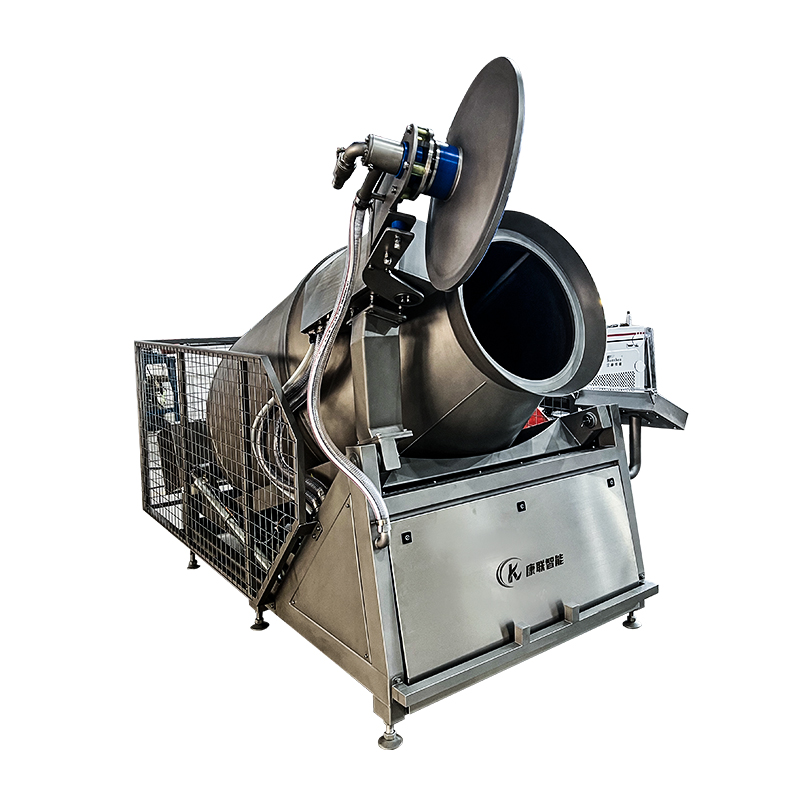
In the competitive meat processing industry, equipment efficiency directly impacts profitability and product quality. The vacuum tumbler machine has become a cornerstone technology for facilities handling everything from small-scale operations to large industrial productions. These machines combine vacuum technology with mechanical tumbling action to achieve uniform marinade penetration, reduce processing time, and enhance flavor distribution across meat products.
However, selecting between different capacity models—particularly the 500L and 1000L variants—requires understanding more than just size. This decision affects your facility's throughput, space utilization, operational costs, and product consistency. The choice between these two popular capacity options will influence your production pipeline for years to come.
The 500L vacuum tumbler represents an ideal middle ground for mid-sized meat processing facilities. A single batch cycle typically processes between 350 and 450 kilograms of product, depending on meat type and density. This size accommodates facilities processing 2,000 to 5,000 kilograms daily through multiple sequential batches.
The 1000L model doubles operational capacity per cycle, handling 700 to 900 kilograms per batch. Facilities running three to four cycles daily can achieve processing volumes of 8,000 to 12,000 kilograms, making this size essential for large-scale operations, retail chains, and export-focused producers.
Production capacity extends beyond raw numbers. Consider cycle time efficiency—the period from loading raw material to discharge of finished product. Most modern machines complete processing in 30 to 45 minutes, including marinade mixing, vacuum application, and tumbling phases. A 500L unit running five cycles daily delivers approximately 2,000 kilograms of finished product, while a 1000L unit operating three cycles produces similar output with reduced equipment stress.
Key Insight: Total daily output depends on cycle count, but energy consumption per kilogram often favors larger units when operating at capacity. A 1000L machine running three cycles may consume less energy per kilogram processed than a 500L unit running six cycles.
Physical space constraints frequently determine machine selection in existing facilities. A 500L meat tumbler machine typically occupies approximately 2.8 by 1.8 meters of floor space, with height reaching 2.1 meters including support structures. Installation requires adequate clearance around loading and discharge points, plus space for supporting equipment such as marinade tanks and ingredient storage.
The 1000L model extends to roughly 3.5 by 2.2 meters with similar height requirements. While the footprint increase appears modest, the actual facility impact includes expanded marinade preparation areas, ingredient staging zones, and output holding space. Many facilities underestimate these secondary space requirements, discovering post-installation that workflow efficiency suffers from compressed staging areas.
Beyond physical dimensions, machine capacity directly affects utility demands. A 500L unit typically requires 15 to 22 kilowatts during operation, while 1000L models consume 25 to 35 kilowatts. Water requirements for cleaning and cooling systems increase proportionally. Facilities must verify electrical service capacity and water supply adequacy before committing to larger equipment, as retrofitting utility infrastructure often exceeds equipment costs.
Consider how either model integrates with existing production lines. The smaller 500L option fits more readily into established workflows and pairs well with existing portioning, packaging, and freezing equipment. Larger 1000L installations frequently require workflow optimization—adding supporting equipment like high-capacity marinators and expanded staging areas—turning a single machine upgrade into a facility-wide improvement project.
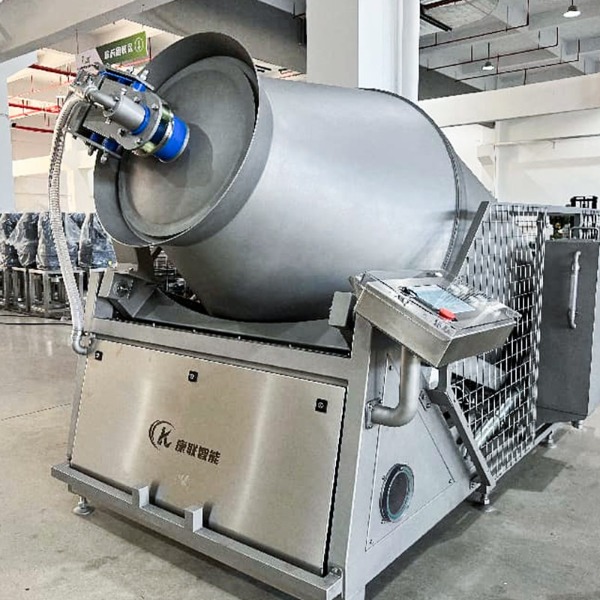
Both 500L and 1000L machines employ vacuum technology to remove air from meat tissues, allowing marinade to penetrate deeper than conventional tumbling alone. The vacuum level achieved—typically 0.08 to 0.1 megapascals—differs minimally between capacity classes when using equivalent machinery. The critical factor involves maintaining consistent vacuum throughout the drum regardless of product volume.
Larger drums create greater distance between bottom-seated meat and the vacuum source. Superior machines compensate through enhanced circulation systems and optimized drum geometry. Budget-conscious 1000L models may struggle maintaining uniform vacuum penetration compared to mid-range 500L units, particularly with dense meat types like beef brisket or pork shoulder.
Professional meat tumbler machines feature intelligent marinade distribution systems. These systems inject marinade while the drum tumbles, preventing uneven saturation. In 500L units, injection points typically number four to six, providing adequate distribution for most cuts. Equivalent 1000L machines may employ eight to ten injection points to maintain similar uniformity at doubled capacity.
Temperature stability during processing affects flavor development and food safety. Smaller machines dissipate heat more efficiently, reaching target marinade temperatures quickly and maintaining consistency throughout longer cycle times. Larger units require supplementary cooling capacity to prevent temperature drift during extended processing, adding operational complexity and cost.
A critical advantage of mid-sized equipment involves processing flexibility. The 500L unit handles varied product types and marinade recipes without modification. Small batches process alongside standard-sized ones at identical cycle times. The 1000L model achieves best economy only with consistent, high-volume product types. Facilities with diverse product portfolios may sacrifice efficiency when forced to wait for full-capacity batches.
Purchase price represents the most visible cost factor. A 500L vacuum tumbler machine typically ranges between 60,000 and 90,000 USD depending on automation level and control systems. The 1000L equivalent spans 100,000 to 150,000 USD. However, per-unit capacity cost proves more favorable at larger scales—the 1000L model costs approximately 50 percent more while offering double the capacity, delivering superior cost-per-kilogram economics at full utilization.
Installation and facility modifications add substantial expense often overlooked in initial budgeting. Electrical upgrades, water line modifications, and workflow restructuring typically add 15 to 25 percent to equipment cost. A 500L installation might require 10,000 USD in supporting work, while 1000L installations often exceed 25,000 USD when comprehensive facility optimization occurs.
Daily operating costs depend on cycle frequency and duty cycle duration. A 500L unit running five daily cycles consumes approximately 110 to 135 kilowatt-hours daily. A 1000L machine running three identical cycles consumes roughly 100 to 120 kilowatt-hours—less total energy despite greater capacity. This efficiency advantage expands with longer operating periods, making large-format equipment increasingly economical for high-volume facilities.
Water consumption for cleaning and temperature management follows similar patterns. Smaller machines require 200 to 300 liters per cleaning cycle; larger units need 400 to 500 liters. However, larger machines require fewer cleaning cycles per unit of product processed, offsetting increased per-cycle consumption.
Mechanical stress directly correlates with component wear. A machine running at 70 percent capacity experiences less bearing stress, vacuum seal degradation, and motor fatigue than one operating at 95 percent capacity. A 500L unit handling 3,500 kilograms daily operates more conservatively than a 1000L machine processing 10,000 kilograms, potentially extending maintenance intervals and component lifespan by 20 to 30 percent.
Replacement component costs remain proportional to machine size. Drum seals, vacuum pump elements, and motor assemblies for larger units cost 30 to 50 percent more. However, larger machines require fewer replacements relative to processed volume when operating within design parameters.
ROI calculation depends on product value, marinade cost savings, and production volume growth projections. Facilities processing premium products—specialty sausages, flavored cuts, or export-grade prepared meats—recover equipment investment through improved yield and reduced waste. A 500L installation typically achieves ROI within 24 to 36 months for established operations, while 1000L equipment often requires 18 to 28 months due to superior per-unit economics, contingent on maintaining near-full capacity utilization.
Modern vacuum tumbler machines employ variable frequency drives (VFD) or frequency conversion systems that optimize motor speed based on load and product type. This technology becomes more valuable in larger machines where speed variations create significant energy savings. A 1000L unit with frequency conversion can reduce energy consumption by 15 to 20 percent during light-load cycles, compared to 500L models where mechanical advantages prove less dramatic.
Both capacity classes offer programmable logic controller (PLC) integration, allowing preset recipes for different product types. A 500L unit's control system handles basic parameters: vacuum level, tumble speed, cycle duration, and temperature targets. Larger 1000L installations benefit from expanded control capabilities: multi-stage processing, adaptive vacuum adjustment based on product feedback, and integration with facility-wide production management systems.
Professional operations increasingly require process documentation for food safety compliance and traceability. Mid-sized 500L equipment typically logs basic cycle parameters to internal memory. Premium 1000L systems incorporate cloud connectivity, real-time monitoring dashboards, and automatic alert systems that notify operators of process deviations, streamlining quality assurance and regulatory documentation.
This table synthesizes key specifications for informed decision-making:
| Specification | 500L Model | 1000L Model |
|---|---|---|
| Nominal Capacity | 500 liters | 1000 liters |
| Practical Batch Load | 350-450 kg | 700-900 kg |
| Cycle Duration | 30-45 minutes | 30-45 minutes |
| Floor Footprint | 2.8 x 1.8 m | 3.5 x 2.2 m |
| Power Requirement | 15-22 kW | 25-35 kW |
| Vacuum Range | 0.08-0.1 MPa | 0.08-0.1 MPa |
| Typical Price Range | 60,000-90,000 USD | 100,000-150,000 USD |
| Daily Operating Cost | 80-120 USD | 90-140 USD |
Before committing to either model, conduct thorough facility evaluation. Document current production volumes over a representative month, tracking product types, batch sizes, and cycle frequency. Analyze growth trends over the past two to three years—genuine growth rates frequently exceed initial projections, making oversizing less expensive than later capacity expansion.
Engage utility providers to confirm electrical capacity and water supply reliability. Request written confirmation that your facility can support the selected machine's requirements before purchase. Many facilities discover infrastructure limitations only after equipment arrives, forcing costly expedited retrofits.
Equipment capacity changes affect entire production workflows. Introducing a 500L machine to a previously manual operation requires systematic process redesign: marinade preparation timing, ingredient staging, output handling, and packaging coordination all demand adjustment. Smaller capacity changes prove easier to integrate; a facility accustomed to manual 200-kilogram batches adapts more readily to automated 400-kilogram batches than to 800-kilogram volumes.
Training timelines differ significantly. A 500L installation with basic controls requires one to two weeks for operators to achieve proficiency. Complex 1000L systems with integrated automation and data interfaces typically demand three to four weeks of hands-on training plus ongoing technical support during the first month of operation.
Risk-conscious facilities often adopt phased approaches. Starting with a 500L unit allows operational validation of automated marination processes, staff training on equipment operation, and process refinement without overcommitting capital. Once the facility demonstrates consistent operation and realizes production gains, upgrading to a 1000L machine becomes justified by proven demand.
This staged approach sacrifices some economy of scale but provides valuable operational experience and allows recovery of initial capital through improved margins before making larger subsequent investments.
Independent butchers and smaller retail operations typically benefit from 500L capacity. Processing 2,000 to 4,000 kilograms weekly allows batch production of specialty marinades—teriyaki, Mediterranean herbs, Asian fusion preparations—without requiring full-capacity cycles. The equipment operates efficiently during peak demand periods while remaining economically viable during slower seasons.
Dedicated meat suppliers serving restaurant chains require consistent quality and regular product delivery. A 500L unit accommodates 40 to 60 restaurant accounts comfortably, processing customized marinade specifications for different establishments while maintaining scheduling flexibility. Larger operations supplying 100+ restaurants justify 1000L investment through daily high-volume processing.
Major grocery retailers and distribution centers typically operate 1000L equipment or multiple 500L units in parallel. Processing 15,000 to 25,000 kilograms daily demands large-format equipment; smaller machines would require operational bottlenecks. These high-volume facilities also benefit from advanced automation and integration with inventory management systems that larger machines provide.
Facilities producing ready-to-cook meal kits and prepared meat products operate continuously during production windows. A 500L unit serves facilities processing 3,000 to 6,000 kilograms daily of pre-portioned meat products. The 1000L model benefits larger meal kit manufacturers producing 10,000+ kilograms daily where consistent output maintains supply chain efficiency.
Cycle duration remains identical—approximately 30 to 45 minutes—because both machines operate at similar tumble speeds and vacuum levels. The 1000L advantage lies in processing double the product per cycle, not in faster cycles. Three 1000L cycles process equivalent volume to six 500L cycles in the same timeframe, reducing equipment stress and labor overhead per kilogram processed.
Yes, upgrading remains technically feasible. However, the 500L equipment maintains resale value only if it remains functional and demand exists for used mid-capacity equipment. Most facilities that upgrade retain the 500L unit for backup capacity or specialty batches, effectively committing to dual-machine maintenance. Purchasing the larger capacity initially often proves more economical than sequential upgrades.
Both machines employ similar operating principles, but control system complexity differs. A 500L unit with mechanical controls requires minimal training—operators learn to set vacuum level, tumble speed, and cycle duration. Advanced 1000L systems with programmable controls and data logging demand more comprehensive training covering recipe programming, diagnostics, and troubleshooting. Budget 20-30 additional training hours for 1000L operators.
Undersized equipment creates operational bottlenecks, forcing overtime operation beyond design specifications. Motors overheat, vacuum seals degrade prematurely, and cycle failures increase. A 500L machine processing 8,000 kilograms daily requires 16+ operating cycles, leading to component failures within 18 to 24 months. Replacement costs and downtime typically exceed the savings from selecting undersized equipment.
Absolute daily energy consumption increases with machine size, but per-kilogram processing cost often decreases. A 500L unit running five cycles daily consumes approximately 550 to 675 kilowatt-hours weekly. A 1000L machine running three daily cycles consumes 500 to 600 kilowatt-hours weekly while processing similar or greater volume. The larger machine proves more energy-efficient at utilization rates above 70 percent.
Well-maintained equipment operates reliably for 10 to 12 years, with major component replacement needed around year seven to eight. Machines operating at design capacity limits achieve longer lifespans than chronically overloaded equipment. A properly sized 500L unit may outperform a undersized 1000L unit by several years due to reduced mechanical stress.
Yes, both models accommodate poultry, seafood, and plant-based protein processing. Some facilities use equipment for marinating prepared vegetable products, though marinade penetration differs significantly from animal proteins. Discuss specific application requirements with equipment suppliers to confirm suitability before purchase.
Standard warranties typically cover one year from installation, including parts and labor. Extended warranties available through manufacturers typically cost 15 to 20 percent of equipment purchase price for five-year coverage. Prioritize suppliers offering responsive technical support, readily available replacement parts, and operator training resources within reasonable proximity to your facility.
More injection points (8-10 in 1000L units versus 4-6 in 500L) distribute marinade more evenly, particularly in larger drums. However, beyond optimal injection frequency, diminishing returns occur. Professional 500L machines achieve comparable uniformity to basic 1000L units through superior circulation design and controlled injection timing. Equipment quality matters more than raw capacity for achieving consistent flavor.
Oversizing typically creates inefficiency rather than capability. A 1000L machine operating at 30 percent capacity for several years consumes excess energy, requires costly maintenance for underutilized components, and ties up capital that could fund other improvements. Select equipment matching your current production plus realistic five-year growth. Upgrading in two to three years of operation proves more economical than deploying oversized equipment prematurely.
Selecting between 500L and 1000L vacuum tumbler machines requires balancing current production needs against growth trajectories, facility constraints against operational efficiency, and capital expenditure against lifecycle cost management. Neither option represents an inherently superior choice—each aligns with different business models and operational contexts.
The 500L model excels for facilities prioritizing flexibility, capital efficiency, and operational simplicity. Its space efficiency and modest utility requirements suit diverse production environments. The 1000L format delivers superior per-unit economics for high-volume, standardized operations while enabling advanced automation and process integration.
Base your selection on documented production data, verified facility capacity, and realistic growth projections—not on manufacturers' marketing or industry anecdotes. Request pilot testing or demonstration trials when possible. Consult with equipment specialists regarding your specific product types and processing requirements. The investment will influence your facility's productivity and profitability for a decade or more, justifying thorough analysis before commitment.
Whether you select the 500L or 1000L configuration, choosing quality equipment with reliable support ensures years of consistent marination results, reduced waste, and sustainable business operations.
Introduction: The New Era of Food Defrosting Technology The global demand for frozen food products h......
READ MOREIntroduction to Advanced Food Preservation The evolution of food preservation technology has reached......
READ MOREIntroduction: What Is a Tunnel Freezer? A Tunnel Freezer is a specialized industrial freezing system......
READ MORE1. Introduction In the context of the global food processing industry's continuous growth, food safe......
READ MOREDevelopment Concept
Guided by our core principle of quality, we have always adhered to the business purpose of "starting with pursuit and ending with satisfaction.
 +86-13967365006
 +86-573-82723906
 zhejiangkanglian@gmail.com
 No. 351 Xinfei Road, Fengqiao Town Industrial Park, Nanhu District, Jiaxing City, Zhejiang Province, China
Copyright © 2023 Zhejiang Kanglian Intelligent Equipment Co., Ltd. All Rights Reserved. Privacy Global Technical Support for Custom Food Processing Equipment