 English
 Español
 عربى
عربى


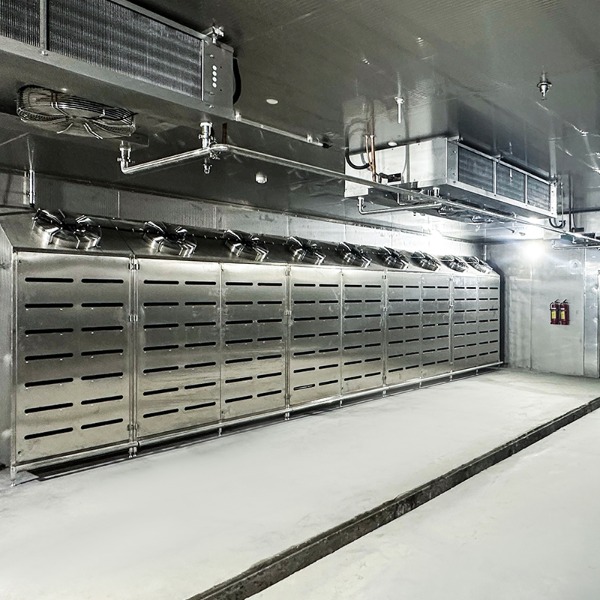
High-speed freezing equipment (also known as blast freezers or individual quick freezers) is industrial machinery that rapidly lowers product core temperature to -18°C or below within minutes to hours, rather than the 12–24 hours required by conventional freezers. It works by combining forced high-velocity cold air circulation (from -30°C to -60°C) with intelligent airflow design to achieve extremely high heat transfer rates — typically 5 to 20 times faster than standard static freezers. This speed creates micro-ice crystals that preserve cellular structure, texture, and nutrients, making it indispensable for high-value food, pharmaceutical, and chemical processing.
When conventional freezers freeze slowly, large ice crystals grow inside cells, rupturing membranes and causing drip loss, mushiness, and nutrient degradation. High-speed freezing equipment solves this by forcing the product through the maximum ice crystal formation zone (-1°C to -5°C) in under 30 minutes.
Forced convection heat transfer: High-power fans (air velocity 2–5 m/s) circulate ultra-cold air directly around the product, breaking the insulating boundary layer of still air.
Continuous or batch configuration: Tunnel freezers (continuous) move products on mesh belts at speeds adjustable from 5–50 mm/min; batch cabinets freeze palletized loads.
Automated defrost and monitoring: Sensors track core temperature, triggering defrost cycles without stopping production. Modern units achieve freezing rates of 5–10 cm/hour (compared to 0.2–0.5 cm/hour in blast freezers).
Example: A 25 mm thick raw salmon fillet takes 18–22 minutes to go from +4°C to -18°C in a high-speed impingement freezer, vs. 4.5 hours in a standard blast freezer — preserving 95%+ of natural juices vs. 65–70% in slow freezing.
Different designs serve distinct product geometries and production volumes. The table below compares four dominant types:
Performance comparison of high-speed freezers
| Type | Freezing time (25mm product) | Typical capacity (kg/h) | Best for |
|---|---|---|---|
| Individual Quick Freezer (IQF) spiral | 8–15 min | 500–5000 | Small individual pieces: berries, shrimp, diced vegetables |
| Impingement freezer | 4–10 min | 200–2000 | Flat products: burgers, fillets, pizzas, pancakes |
| Cryogenic (LN2 or CO2) tunnel | 1–5 min | Up to 4000 | High-value, irregular shapes; surface crust freezing |
| Fluidized bed freezer | 3–8 min | 300–3000 | Sticky or fragile products: peas, diced carrots, grated cheese |
Data source: Industry standard performance curves (GEA, JBT, Linde, 2023–2025 benchmarks).
Frost-free freezing equipment integrates automated defrost cycles that prevent ice buildup on evaporator coils without interrupting freezing operations. This is not a separate machine type but a feature set within high-speed freezers. Frost accumulation reduces heat exchange efficiency by up to 40% and increases energy consumption by 25–35%.
Quantitative benefit: A frost-managed high-speed freezer maintains 92–96% of its initial heat transfer coefficient over a 16-hour shift, compared to 55–65% in a conventional unit without active defrost management. This translates to 18–22% lower energy costs per kg of frozen product.
High-speed freezing equipment is not a generic solution; it delivers ROI through specific quality and yield improvements. Below are real-world performance gains:
For a medium-sized frozen berry processor (2000 kg/hr), upgrading from a standard blast freezer to a fluidized-bed high-speed freezer reduces annual electricity use by an estimated 187,000 kWh (≈ $22,400 at $0.12/kWh) while cutting product giveaway from ice glaze by 3.1% — pure margin improvement.
To avoid overspending, match equipment type to your product’s initial temperature, shape, fragility, and throughput. Use this checklist:
A typical frost-free spiral freezer with 1000 kg/h capacity has a capital cost of $180,000–$350,000. Payback period, driven by reduced product loss (typically 3–7% yield improvement) and lower energy, ranges from 18 to 36 months for continuous operations.
Modern high-speed freezers incorporate variable frequency drives (VFDs) on fans and compressors, along with ammonia or CO₂ refrigerant systems that have lower GWP (Global Warming Potential) than HFCs. Energy consumption per frozen ton has dropped 40% since 2015, with best-in-class units achieving 55–75 kWh per metric ton of frozen product.
Key metric: The Specific Energy Consumption (SEC) for high-speed freezing equipment is now as low as 35 kWh/ton for cryogenic CO₂ systems (though CO₂ itself adds cost), and 48 kWh/ton for electric-driven ammonia spiral freezers with full frost management. Always request SEC data from multiple vendors — differences of 10–15 kWh/ton translate to $8,000–12,000 annual electricity cost per 1000 annual operating hours.
High-speed freezing equipment delivers superior product quality by crossing the critical -1°C to -5°C zone in under 30 minutes, while frost-free designs maintain thermal efficiency above 90% over extended runs. For any business freezing more than 500 tons/year of sensitive products (meat, seafood, prepared meals, berries, or pharmaceuticals), the combination reduces waste by 3–8% and energy by 15–25% compared to conventional blast freezers. Always verify freezing rate (cm/hour) and defrost interval (hours between cycles) in technical specifications — these two numbers predict your real-world operating cost and product yield more reliably than brochure claims.
Introduction: The New Era of Food Defrosting Technology The global demand for frozen food products h......
READ MOREIntroduction to Advanced Food Preservation The evolution of food preservation technology has reached......
READ MOREIntroduction: What Is a Tunnel Freezer? A Tunnel Freezer is a specialized industrial freezing system......
READ MORE1. Introduction In the context of the global food processing industry's continuous growth, food safe......
READ MOREDevelopment Concept
Guided by our core principle of quality, we have always adhered to the business purpose of "starting with pursuit and ending with satisfaction.
 +86-13967365006
 +86-573-82723906
 zhejiangkanglian@gmail.com
 No. 351 Xinfei Road, Fengqiao Town Industrial Park, Nanhu District, Jiaxing City, Zhejiang Province, China
Copyright © 2023 Zhejiang Kanglian Intelligent Equipment Co., Ltd. All Rights Reserved. Privacy Global Technical Support for Custom Food Processing Equipment


